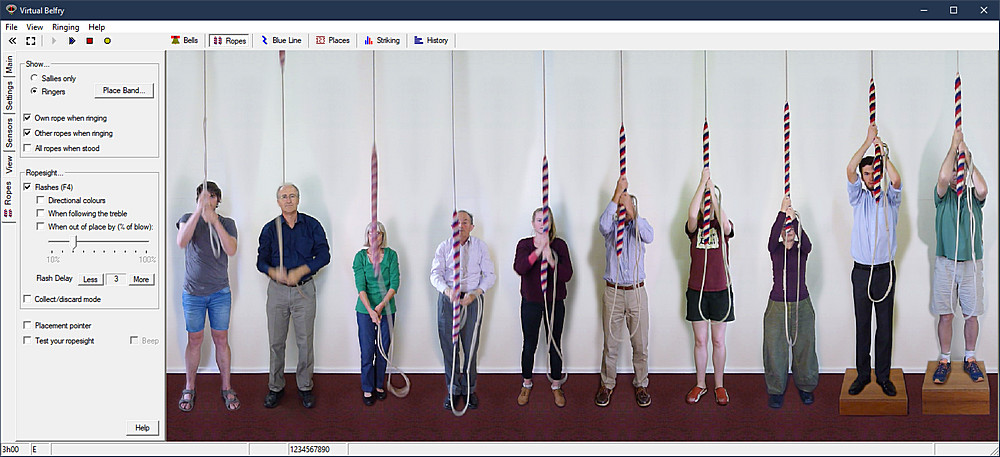
The Ropes window provides a band of ringers for you to ring with, allowing for ropesight teaching and practice and an immersive ringing experience. The images for the animated ringers must be downloaded and installed separate to the program (at no additional cost). Download the images from the downloads page.
Normally, bells are selected for ringing by choosing preset options on the main control panel (six, eight, etc.), but you can use the Ropes window to select any desired assortment of ropes.
Once ringing starts, any ropes/ringers that are not being used are removed from the scene, leaving the selected ones to fill the window.
If you are ringing a real bell, using Virtual Belfry as a simulator, and you have "Hide Own Rope" ticked on the control panel, your own rope will vanish from the window as soon as you join in, leaving a gap in the band.
Flashes
When the option for Ropesight Flashes is chosen on the control panel, a coloured circle is drawn momentarily over different ringers at specific times. The timing of the flashes is designed to draw the ringer's attention to a rope at about the time that normal ropesight would do the same job. There is also a delay setting to vary the timing of the flashes, which may be useful as your ropesight develops so that you have a chance to spot the next rope without assistance before the program reveals which one it is.
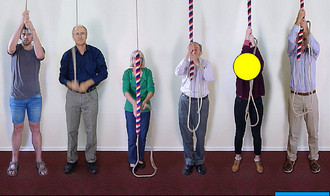
You can choose different coloured flashes to indicate whether you are hunting up, hunting down or staying in the same place for the next blow. You can limit the flashes to just when you are following the treble, or - perhaps most usefully - have them appear only when you are out of place (by an amount that you can control).
Collect/discard mode
With this option ticked, ringers acquire or lose big green ticks progressively to show the way in which ropes are "collected" one by one when hunting from the front to the back, and "discarded" on the way back down to the lead. It is best used just for hunting, on six or eight bells, starting on the treble.
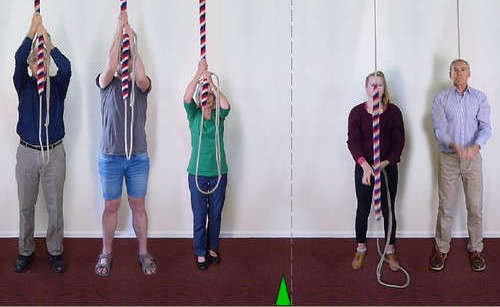
(This option is really only useful when ringing rounds. Once the bells are in some order other than rounds, the position of the green arrowhead becomes rather meaningless.)
There is a button at the top that opens a dialog for choosing the ringers you want from the available selection of ten (a number that might increase at a future date). The default band placement is probably good for most purposes, but if you have an old computer that is quite slow or doesn't have much RAM, you might choose to place, say, only three or four ringers repeatedly. This would make the loading quicker.
The results of the ropesight test are also shown on the control panel.
Ropesight Game
This is a way to test your own ropesight while sat at a computer, using the ropesight flashes described above. A mouse is essential. The object of the game is to point the mouse at the next ringer before the flash occurs. Your success rate is shown as a blue bar up the left hand side of the window and the final results are shown afterwards in a box on the control panel.
The Control Panel
Options on the control panel for the ropes (see the image at the top of this page) allow you to choose: